Can I take over a seller's low interest rate instead of taking a new loan?
By Edelio Sanchez
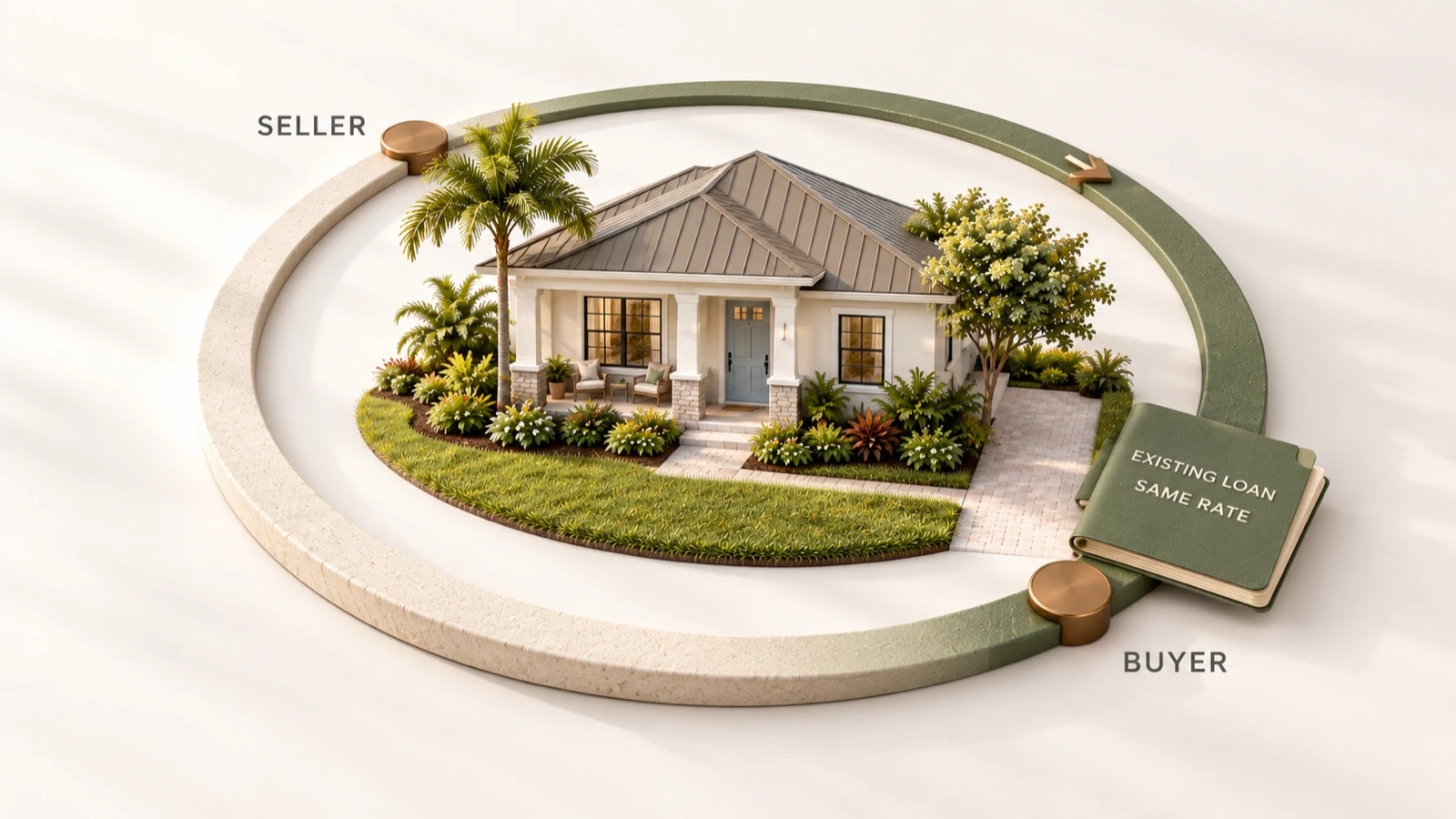
If the seller financed with an FHA, VA or USDA loan, that loan may carry an assumption clause, which means a qualified buyer can take it over at the rate the seller already has instead of borrowing at today's rates.
Now the part most articles skip. Assuming a mortgage does not make it easier to qualify. It makes the payment cheaper for someone who can already qualify. That distinction is the whole article, and almost nobody writing about this online says it out loud.
What does assuming a mortgage actually mean?
You buy the house. Instead of taking out a brand new loan at whatever rates are doing this week, you step into the loan that is already on the property and keep its rate, its remaining balance and its remaining term.
The seller walks away from the debt. You take it over. Their old rate becomes your rate.
Which loans can be assumed, and which cannot?
Government backed loans carry assumption clauses. Conventional loans, for the most part, do not.
The reason is historical. When rates spiked in the 1980s, buyers started assuming older low rate loans instead of taking expensive new ones, and lenders wrote assumption clauses out of their conventional paperwork. They could not do that to FHA and VA paperwork, because changing those terms takes an act of Congress.
So the question to ask about any house you like is simple: how did the current owner finance it? If the answer is conventional, this path is closed and you are buying at today's rates. If the answer is FHA, VA or USDA, there is something worth checking.
FHA and VA are the straightforward ones. USDA loans can be assumed too, but the rules are narrower in a way that will decide it for most people. USDA lending carries an income limit and a geographic eligibility requirement, and both of those apply to the person taking the loan over, not just to the person who originally took it out. So a USDA assumption only works if your household income falls under the cap for that county and the house sits in an eligible area. Around here that is worth checking rather than assuming, because eligibility can change from one side of a road to the other.
Do I need to be a veteran to assume a VA loan?
No, and this one surprises almost everybody. A VA loan can be assumed by a buyer who never served. The catch sits on the seller's side, not the buyer's: when a non veteran assumes a VA loan, the seller leaves behind the portion of their VA entitlement that is tied to that property, and they do not get it back until the loan is paid off.
That is a real cost to a seller, and any honest conversation about it says so up front. It is also negotiable, like everything else in a contract.
So what is the catch?
The catch is the gap between what the house costs and what is still owed on it.
Say a house is listed at $400,000 and the seller still owes $300,000. The gap is $100,000, and that money has to show up at closing. It is not a down payment. It is the seller's equity, and they are entitled to it.
Those are round numbers I chose to show the arithmetic. They are not a listing and they are not a quote.
Here is the useful way to think about it, and I got this from the training I took on this: what matters is not the dollar size of the gap, it is the gap as a percentage of the price. A $100,000 gap on a $400,000 house is a very different conversation from a $100,000 gap on a $250,000 house.
For scale, this is not a rare situation. As of the third quarter of 2025, 78.8 percent of US homeowners who carry a mortgage had a rate below 6 percent. Read that number carefully: it is a share of borrowers, not of all homeowners, because only about 60 percent of owners have a mortgage at all. Rate distribution as of Q3 2025. Source: Redfin analysis of the FHFA National Mortgage Database.
The gap also grows every month, for two reasons at once. The seller keeps paying the balance down, and the house keeps being worth more than they paid. The best assumable loans were written between roughly 2019 and 2021, and every month that passes makes them a little harder to use. That is not a sales line, it is just arithmetic.
How does a second mortgage close the gap?
If you have the full gap in cash, you bring it and you are done. That is the clean version and it needs no second loan.
Most people do not have it. So the other path is a second mortgage that covers the difference between your cash and the gap. It closes at the same time as the assumption, in one closing.
You end up with two payments to two different companies. One on the assumed loan at the seller's old rate, one on the second at today's second mortgage rate. Add them together, spread them back across the total borrowed, and you get what people call a blended rate. It lands between the two. How close it lands to the good end depends on how big the gap is relative to the price.
Two honest notes about the second. A second mortgage is riskier for the lender than a first, so its rate is always higher than a first mortgage rate. And in practice the lenders doing these want to see at least ten percent of the purchase price from you in cash. Below that, the terms get bad fast.
Who does this actually work for?
In my experience and from the training, the honest list is shorter than the internet suggests:
- Someone who already owns a home, has equity, and will not give up their current rate to move. This is the biggest group by far.
- A move up buyer who can qualify today but is being beaten by the monthly payment.
- A downsizer with real cash from the last house.
- An investor with strong financials.
What they all have in common is that the approval was never the problem. The payment was.
If you are the one who owns a low rate loan rather than the one trying to use it, the other side of this is worth reading too: your old mortgage might be the thing that sells your houseyour old mortgage might be the thing that sells your house/blog/your-low-rate-mortgage-might-sell-your-house.
Who does it not work for yet?
If a lender turned you down last month, an assumption is probably not your door, and I would rather tell you that now than walk you through six weeks of hope.
The servicer still underwrites you. They still pull credit, verify income and look at reserves. The second mortgage that covers the gap has its own separate approval, and it usually wants at least ten percent of the price in cash on top of that.
If that is where you are, start somewhere else. Read what to do when a lender says nowhat to do when a lender says no/loan-denied, and read can I actually buy a house right now?can I actually buy a house right now?/first-time-buyers. Get the file fixed first. Then come back and we will look at assumptions with real options open to you, because the math on them is genuinely good once you can walk through the door.
How long does it take, and what does it cost?
Longer than a normal closing, and the reason is worth understanding.
The company that decides is the servicer, not a local loan officer you can call. Two things are true at the same time: the loan is legally assumable, and the servicer often has no interest in helping. Servicers have told sellers outright that they do not do assumptions on loans that are plainly assumable.
That is why a small industry exists that does nothing but push these approvals through, and why I work with one instead of trying to run it myself. There is a fee for that service and I will tell you exactly what it is before you commit to anything.
How do I find these homes around Clermont and Horizon West?
Through eXp I have access to a platform called AssumeList, which maps homes with assumable loans, both on the market and off, and shows an estimated rate and an estimated cash gap for each one. Florida is one of the states it covers, and I have run live searches on Clermont, Minneola, Winter Garden and Horizon West. All four come back with options.
Two things worth knowing. The rates it shows are estimates, not the note rate, so before anybody gets excited we confirm the real number against the seller's actual mortgage paperwork. And I can set you up with your own search account under mine at no cost to you, which is not something you can get on your own at that price.
What is the honest summary?
Assumable loans are one of the few real affordability tools left in this market, and almost nobody in it knows how they work. They are also narrower than the excitement suggests: they need a government backed loan on the other side, a seller in good standing, a buyer who can already qualify, and real cash to close the gap.
When those four line up, the monthly savings are not small. When they do not, I will tell you so on the first call.
Frequently Asked Questions
Get the weekly Central Florida market brief
One short email each week: local market updates, fresh listings before they hit the search sites, and practical tips for buyers and sellers in Central Florida.
No spam. Unsubscribe anytime.