My Appraisal Came In Low. What Happens Now?
By Edelio Sanchez
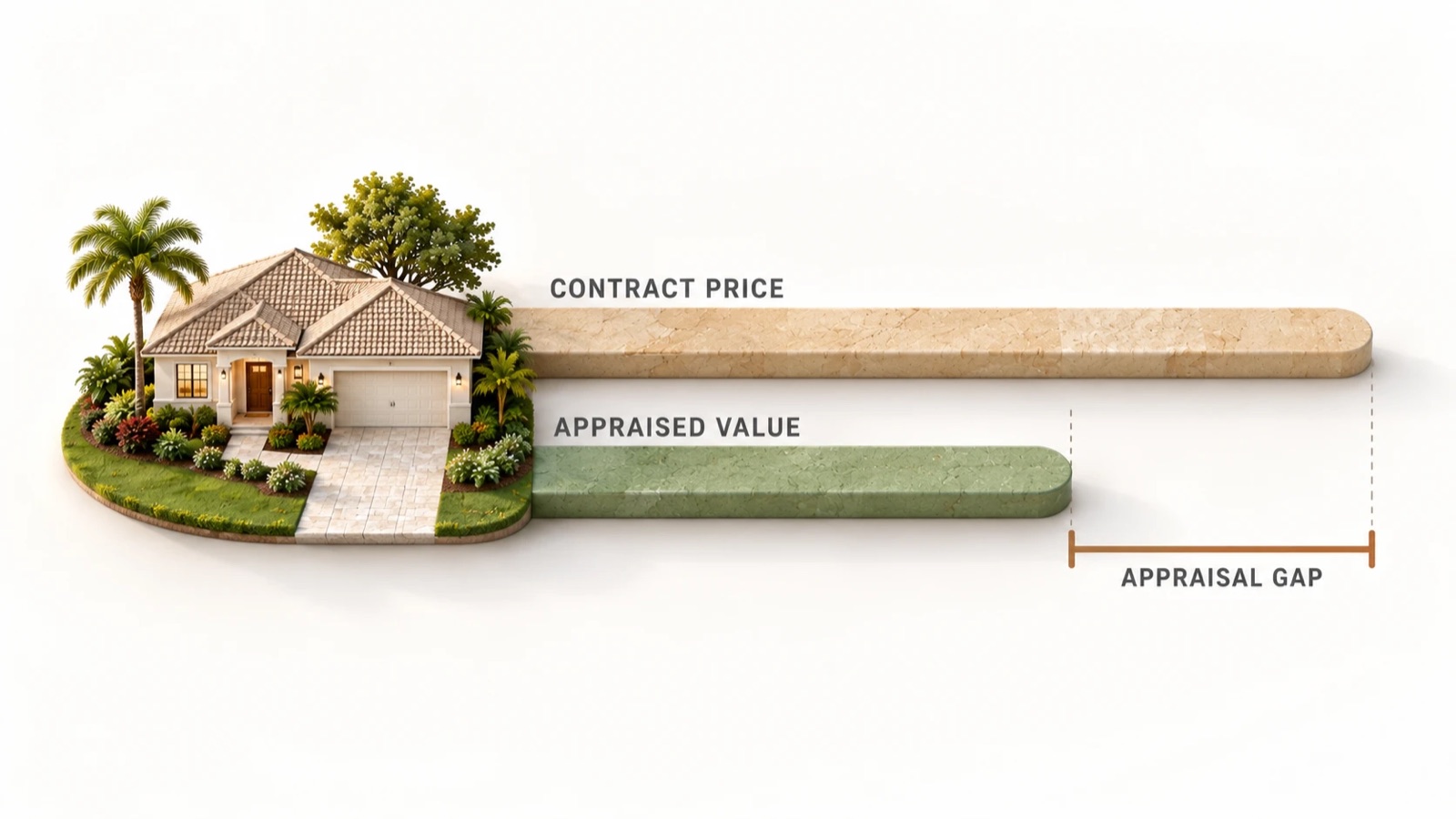
A low appraisal usually does not kill the deal. What it changes is who covers the difference between the price you agreed to and the number the appraiser came back with, and you have more options than most people realize.
I have walked clients through this from both sides of the table. It feels like the deal just died. Most of the time it did not.
What does a low appraisal actually mean?
Your lender is not lending against the price you agreed to pay. It is lending against what the appraiser says the house is worth. If you agreed to a price above that number, the lender still lends on the lower value, and the difference is called the appraisal gap.
That gap is cash that has to come from somewhere. It sits on top of your down payment, it does not come out of it. That is the part that surprises people.
One thing worth hearing clearly: a low appraisal is not a verdict on the house. An appraiser is reporting what recent comparable sales support. In a neighborhood where prices moved quickly, or where very little has sold recently, the comparable sales can lag what buyers are actually paying. The house can be perfectly fine and the number can still come in low.
What are my options?
There are four, and a fifth that people forget.
- The seller lowers the price to the appraised value. This happens more than you would think, especially if the home has been sitting, or if the seller understands that the next buyer's lender will order an appraisal too and will probably land in the same place.
- You cover the gap in cash. Your loan is sized against the appraised value, so you bring the difference to closing on top of your down payment.
- You split it. The seller comes down part of the way and you cover the rest. This is where most of the deals I have seen actually land.
- You cancel. Whether you get your deposit back depends entirely on what your contract says. More on that below.
- You challenge the appraisal. This is the one people forget, and sometimes it is the right move.
Can I get my deposit back if I walk away?
It depends completely on the contingencies in your contract, and this is not a question to guess at.
If your contract still has a financing contingency, or specific appraisal language, you may be able to cancel and recover your deposit. If you waived those to make your offer more competitive, walking away can cost you that deposit.
I am not going to tell you what your contract says without reading it. Pull it up and let us go through the paragraphs that matter together. If the deposit at stake is significant, that is also a sensible moment to have a real estate attorney look at it. Explaining how the process works is my job. Telling you what a contract obligates you to do legally is not.
Is it worth challenging the appraisal?
Sometimes, and asking costs you nothing.
The process is called a reconsideration of value, and it goes through your lender rather than directly to the appraiser. What makes it work is evidence, not disagreement. If there are genuinely comparable sales the appraiser did not use, or if the report contains a factual error about the square footage, the bedroom count, the condition, or the lot, that is worth submitting.
Here is the honest part. A reconsideration is not fast, it is not guaranteed, and "we think it is worth more" is not evidence. It works when a real comparable sale was missed or there is a real mistake in the report. I will pull the comparable sales and tell you straight whether you have a case, because losing two weeks on a challenge that was never going to land is worse than dealing with the gap.
What if I already agreed to cover an appraisal gap?
Then that is what you agreed to, up to the amount you named.
Appraisal gap coverage is a clause where you commit in advance to covering a shortfall, often up to a stated amount, to make your offer stronger. It is a legitimate tool and it wins offers in a tight market, which I cover in how to win when there are multiple offershow to win when there are multiple offers/blog/multiple-offers-how-to-win.
It is also the clause I see people agree to without doing the arithmetic first. If you commit to covering a gap, that money is cash at closing, it is not financed, and it does not build equity. Before you sign one, you should know exactly what the largest number you are willing to write is, and it should be a number you can actually write without draining your reserves. Moving into a house with nothing left over is its own kind of problem.
So what would I have you do first?
Get the actual appraisal report and read it before you react to it.
Look at which sales the appraiser used, how recent they are, and how close they really are to the house you are buying. Half the time the number makes more sense once you see the comparables. The other half, you find the problem.
Then it is two conversations. One with your lender about what the lower value does to your loan and your cash to close. One with me about whether the seller is likely to move, and what a realistic counter looks like.
A low appraisal is a negotiation, not a verdict. Most of the time there is still a deal in there. I would rather walk you through the options than watch you panic and either overpay or let go of a house you actually wanted.
Frequently Asked Questions
Get the weekly Central Florida market brief
One short email each week: local market updates, fresh listings before they hit the search sites, and practical tips for buyers and sellers in Central Florida.
No spam. Unsubscribe anytime.